On breathing, meditation, and zen sports
Or how I will stop mocking things found on Tik Tok.
While I was taking my lactate threshold exam at UC Davis, this sign was taped to the window right in front of my bike. My test administrator shared with me that nose only breathing has been making the social media rounds. Naturally, I mocked it because it sounds ridiculous. Why only use half of the resources you’ve been given? When I start to work out hard, I always breathe in through my nose and out of my mouth.
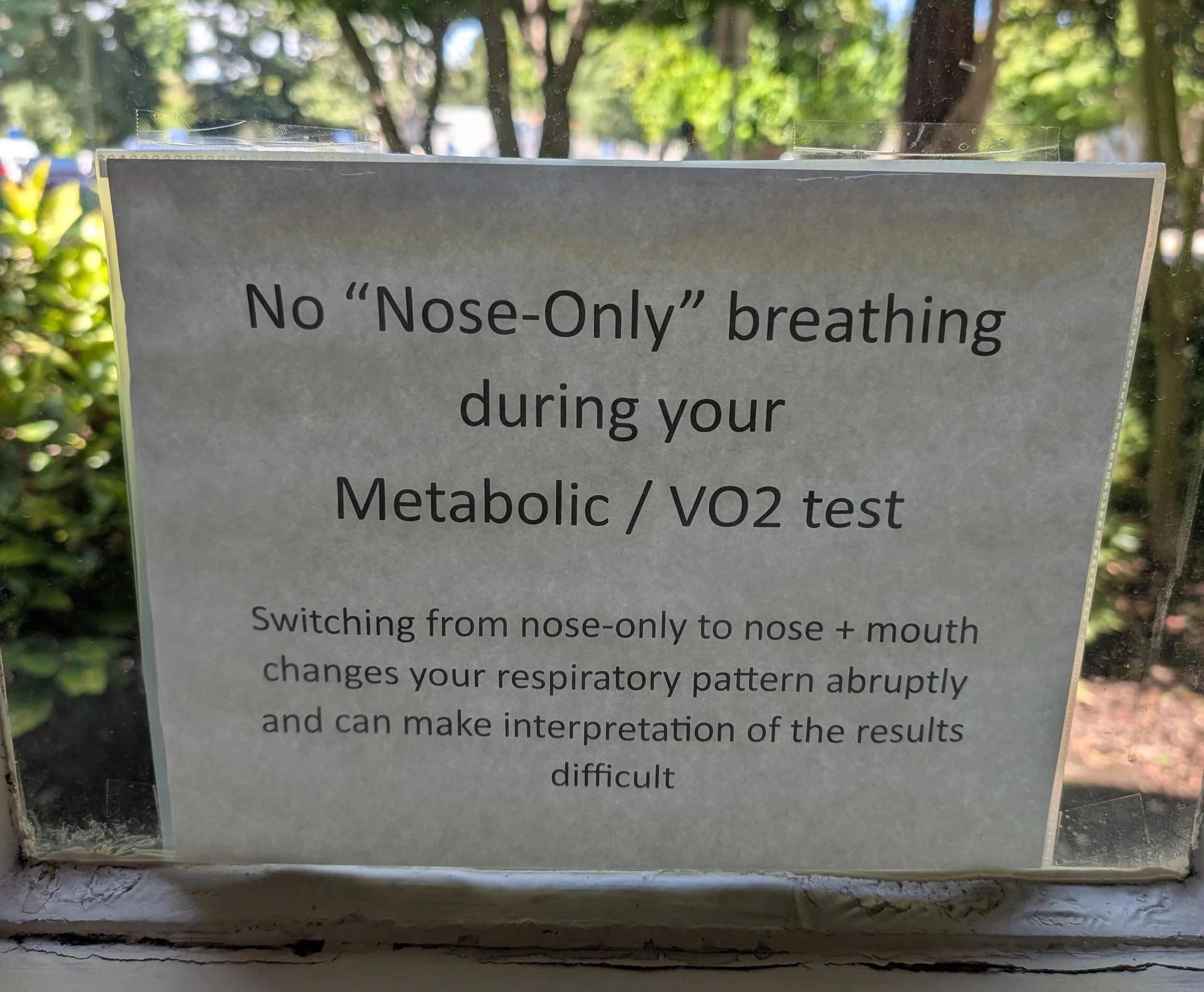
I didn’t give any of this a second thought until I was almost at the end of the exam and I had started to get into my standard “working hard” breathing rhythm which is consists of two short nose inhales and one long and very loud mouth exhale. As a long time casual runner, I naturally fall into this breathing pattern because it lowers my heart rate which enables me to run longer without fatiguing as easily. The test administrator remarked on my heart rate staying pretty even, despite my comical inability to push the pedals any more.
A week passes and I stumble across the book Breath: The New Science of a Lost Art, by James Nestor from 2020. Side note, I got pregnant during the pandemic, this guy writes a seminal work and NYTimes bestseller. Some people know how to manage their time well. The key themes are that modernity has altered the human skull narrowing airways and shrinking the face so that mouth breathing is more widespread. Chronic mouth breathing leads to a whole host of maladies. However, if we all just learn to breathe ‘correctly’ through our nose, then we might not have as many problems - like sleep apnea, diabetes, schizophrenia, or even scoliosis. It sounds like I’m mocking again, and maybe I am, a little, but he has a point.
I grew up ensconced in Buddhism, the way some people go to vacation bible school so they can learn about God year round. Meanwhile, I was learning about meditation. Can you imagine an ADD child trying to stay calm and still for 30 minutes? Everyone else was lucky if all I did was fall asleep. By the way, one teaching that stuck with me was that monks are forbidden to eat 5 foods, in addition to meat. Those are garlic, onions, leeks, chives, and asafoetida. People have speculated why but a child can tell you eating those can lead to distracting yourself and others who are practicing breathwork.
Another side bar: Check out this guy’s substack on Buddhist chants and breathwork.
In Breath, Nestor explores the Tibetan Tummo technique, a breathing and visualization practice used by monks to generate heat and potentially withstand extreme cold. Nestor highlights how this ancient practice, which involves stimulating the sympathetic nervous system, can significantly raise body temperature. In her effort to convince me to meditate more, my mother used to tell me the same story which I thought was a work of maternal fiction bourn out of frustration, see ADD part.
However, no amount of sitting still ever worked for me. It wasn’t until in college, when I started running, that I was able to clear my mind and enter the blissful zen state known as Runner’s High. From there, breathwork like nasal breathing, deep breathing, or fortifying your diaphram — all are easier because your body is singularly focused on getting more oxygen to your muscles.
I subsequently found swimming to be the best sport for breathwork due to the nature of timing your breaths and being forced to hold it for longer intervals or trickle your exhalation. Nestor points out that breathing isn’t about getting more oxygen but about managing CO2. When balanced, CO₂ becomes a powerful ally, helping your body use oxygen efficiently, reducing stress, and optimizing overall health. Perhaps there is something chemical happening too as a result of possibly having more CO2 in your body.
My final thought which I’ve been dancing around is to read the Breath book. Nestor is a good writer. He masterfully weaves the language of science, history and personal experience with evocative and relatable ideas. Like the following which really appeals to someone who smells things as a day job.
“Smell is life’s oldest sense… breathing is so much more than getting air into our bodies. Its the most intimate connection to our surroundings. Everything you or I or any other breathing thing has inhaled is hand me down space dust thats been around for 13.8bn years.”
What are your zen sports or the ones which make you feel the most calm or euphoric? Any breathing experiences you’d like to share? What did you think of Nestor’s book?