Surviving the Suck
Finding your pilot after the in-water mass start at Swim the Suck is tough enough, but my biggest challenge was surviving mine.
In endurance sports, finding a rhythm early is everything. My plan was to count ten strokes, breathe to the right, and sight off my pilot. It was working beautifully—until I noticed her kayak creeping closer and closer, ending in a direct hit to my face.
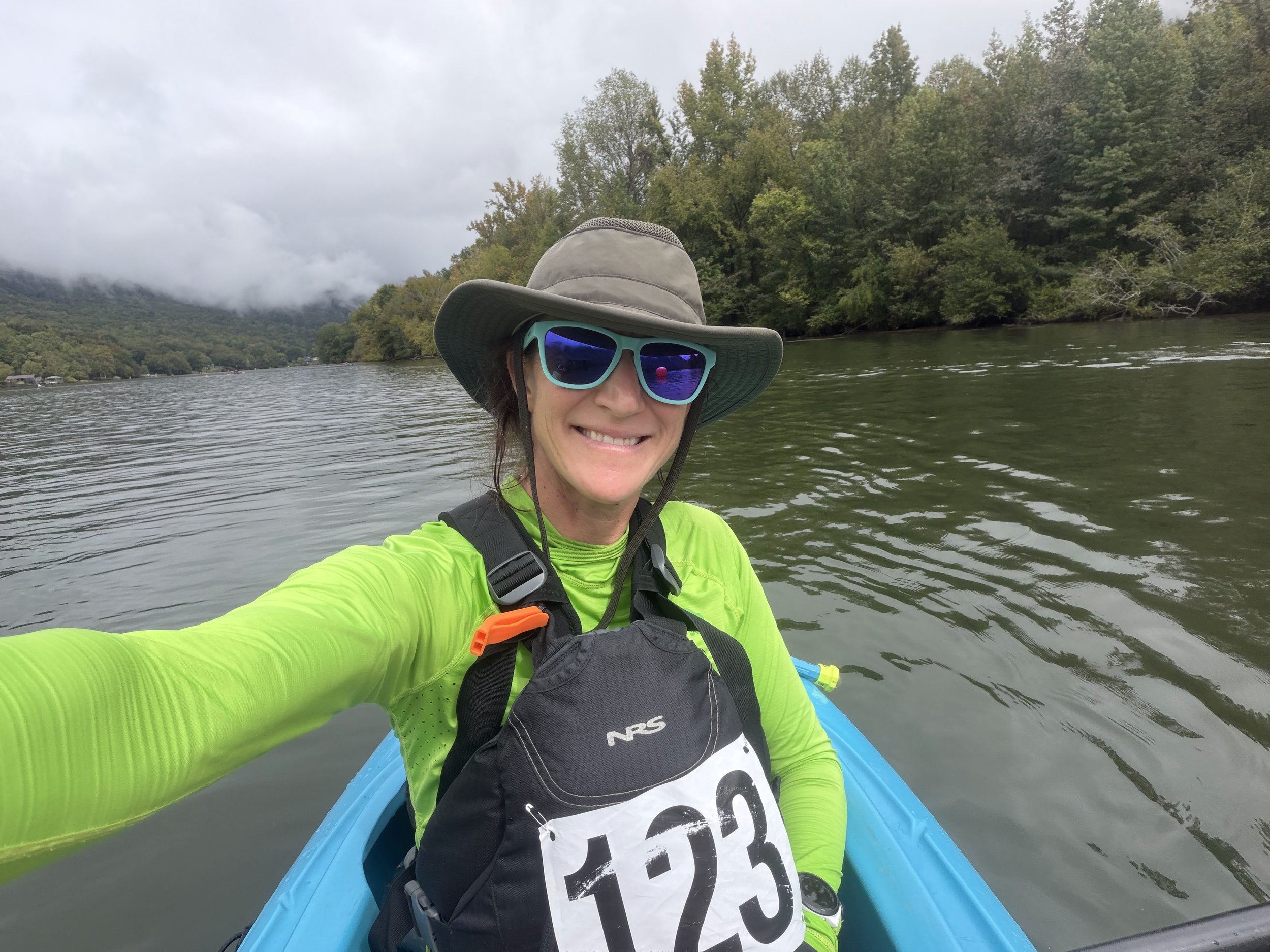
You can train for ten months for your first marathon swim, but you never think to practice evading your own support crew.
Back to the Start
Last year, I bicycled 1,200 miles along Route 66. Standing on the Santa Monica Pier, I realized that over the past 15 years, I had cumulatively cycled the length of the United States from New York to Los Angeles—and I don’t even like cycling. Coming off that adrenaline high, I searched for a new challenge worthy of building toward a larger bucket-list goal.
That's how I discovered marathon swimming. One thing led to another, and before long, I'd signed up for Swim the Suck, a ten-mile downstream river race through the Tennessee River Gorge.
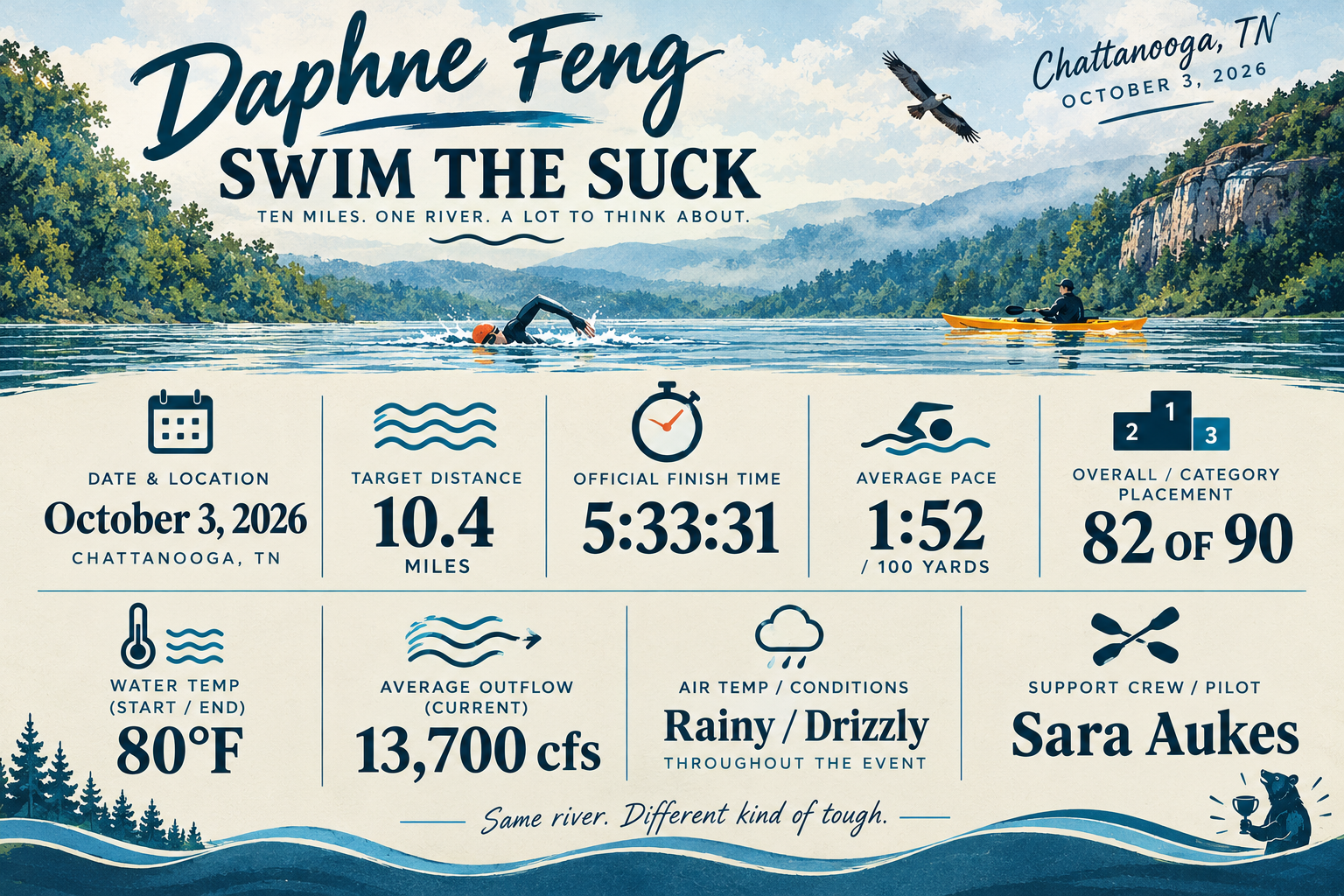
Source: ChatGPT
Before the race, I spent a ridiculous amount of time trying to predict what ten miles in the Tennessee River would feel like. The race organizers publish historical current speeds and water temperatures dating back to 2010, so I studied them religiously. I read race reports*, calculated how much the current might push me, and tried to estimate my finish time.
Mostly, I wanted warm water. I knew I wasn't going to be fast, and if I was going to spend five or six hours in a river, I wanted those hours to be comfortable. So I made a pact with the devil: give me warm water, and I wouldn't complain about the lack of current.
And the devil heard me.
I got near-ideal conditions: a 7:30 AM air temperature of 71°F, water at 80°F, an overcast sky that lasted until late afternoon, and glassy water undisturbed by wind. We also got sporadic rain, which I hadn't asked for, but isn't that how all Faustian bargains go? You always get something extra.
Expectation vs Reality
When I signed up for Swim the Suck, I imagined myself gliding through a gorgeous river gorge, with trees and mountains rising around me. The water would be calm and placid. Birds of prey would soar overhead. Maybe a fish or two would leap from the water.
Chattanooga did not disappoint. It's nicknamed the Scenic City, and it lives up to the name. The river, the watershed, the gorge—spectacular.

Source: Tennessee River Gorge Trust
Everything I'd imagined came true. It was a picturesque day in the gorge, made even more atmospheric by a blanket of fog draped lazily over the treetops, little white tendrils extending toward the water's edge. I was there, surrounded by trees and mountains, with an osprey soaring overhead.
It was an idyllic scene to behold – for my pilot.
Source: Sara Aukes
For me, it was mostly dark, murky water. My face was down, watching my hands disappear into the darkness and reemerge, stroke after stroke. Every ten seconds or so, I'd lift a goggled eye out of the water to sight, catching a glimpse of my pilot out of the corner of my eye, sometimes a bird flying above her.
During the thirty seconds I spent feeding every thirty minutes, I could look around and appreciate where I was. Over the course of a ten-mile swim, that amounted to about four and a half minutes of sightseeing.
The rest of the time, I was alone with my thoughts.
And that, more than anything, was what I hadn't anticipated. Marathon swimming is lonely and isolating—and, dare I say it? A little boring. You have to be very comfortable entertaining yourself.
We tend to imagine extraordinary physical accomplishments as exhilarating, adrenaline-fueled feats. The reality can be profoundly mundane. The achievement isn't necessarily enduring something spectacular. It's being willing to be bored for a very, very long time.
Maybe endurance isn't about learning to love suffering. Maybe it's about learning not to need constant stimulation.
What I Got Right
PACING
I estimated my pace accurately, holding a consistent 1:52 per 100 yards across the entire ten miles. Again, I’m not a real swimmer; I just played one for the day.
EQUIPMENT
My suit, a Jolyn triangle top paired with Pam bottoms, was fantastic. Cinching it down, even the bottoms, made me feel bulletproof. Did I look like I was heading out to frolic at the beach in a string bikini? Maybe. But I was supported, comfortable, and nothing shifted or jiggled. I had minor inner-arm chafing from striking the fabric, though I attribute that more to stroke mechanics than the suit itself.
I use prescription goggles from GogglesnMore, which provided an extra layer of clarity, visibility, and comfort. They come with a reusable anti-fog cloth which is outstandingly effective.
For GPS, I used the Garmin Fenix 7 Pro Sapphire Solar. It does waaay more than I could ever need. Did I just figure out how to use Drill Log for swimming? Yes.
NUTRITION SCHEDULE
Feeding every 20 to 30 minutes was the perfect cadence to keep my energy steady to the end.
MY CREW
Did I pick the right pilot? Given that she spent the first five miles learning how to paddle in a straight line—while her spouse is an accomplished kayaker with hundreds of nautical miles under his belt—I might have chosen poorly on paper. On the shuttle bus, she even verbalized the scenarios in which she felt it was ok to throw a water bottle at my head. (There is no scenario where throwing a bottle at a swimmer is an acceptable communication strategy; it’s in the pilot handbook. She didn't read hers.)
And yet, as my soulmate, I couldn't have picked better. Her presence calms my nerves, her constant preparation for unlikely calamities is endlessly entertaining, and she kept me anchored.
So yes: the right pilot.
What I Got Wrong
NUTRITION
I'd trained with Spring Energy oatmeal endurance packs, because real food agrees with my stomach.
About an hour into the swim, though, it became clear that my body wanted something it could access more quickly. I switched to Neversecond C30 gels, alternating them with Huma Chia gels, and added a couple of each that were caffeinated. The combination gave me the boost I needed.
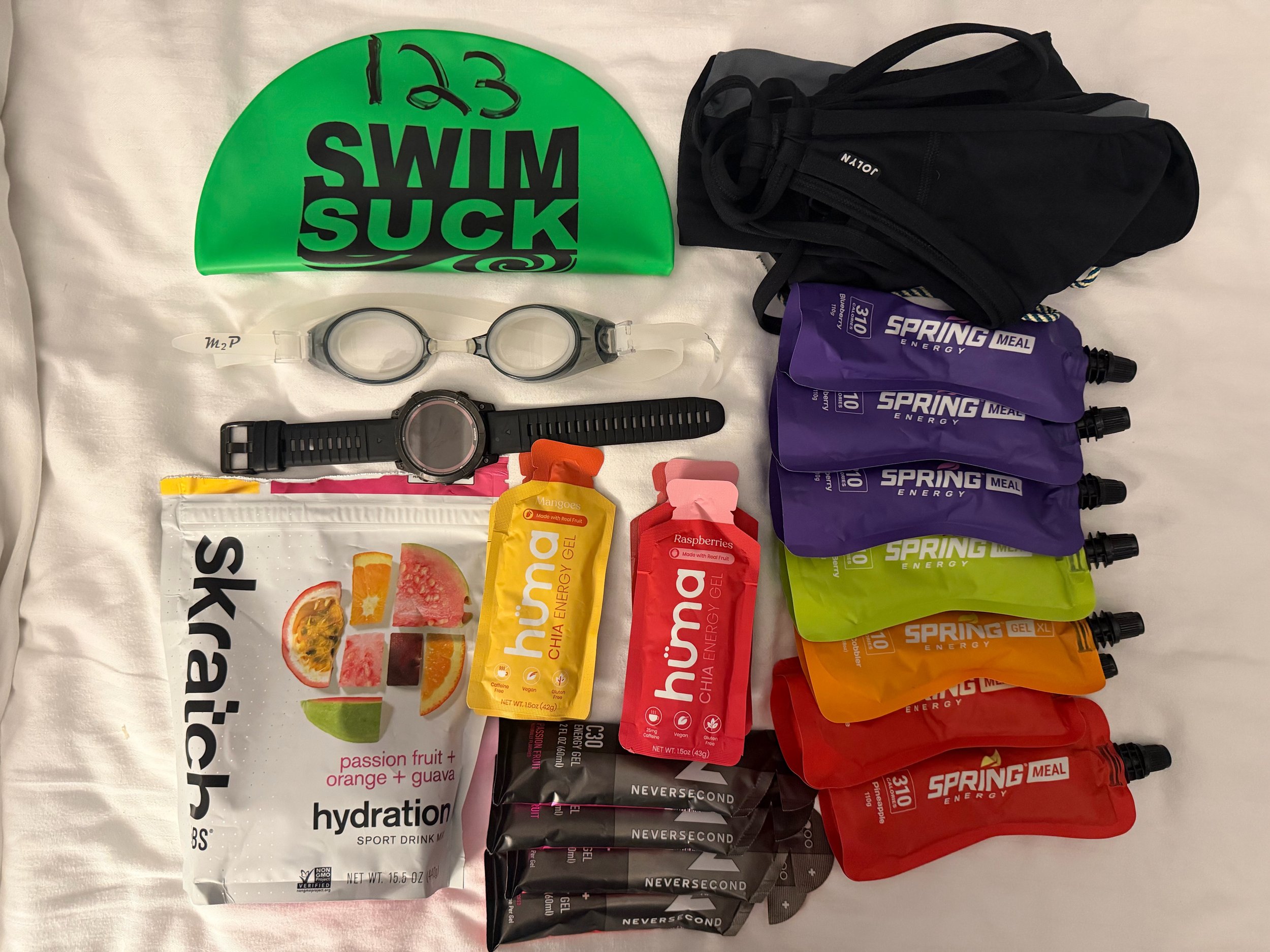
I didn’t even use half of this nutrition. Source: Daphne Feng
I'd also brought a gallon of Skratch Labs hydration mix and ended up drinking less than 32 ounces. Early in the race, I got a little too enthusiastic and drank too much at once. I spent the next mile feeling liquid sloshing around in my stomach—a stark reminder that even water needs pacing.
PEEING
I never mastered peeing mid-stroke. I had to stop, lie face down, fully relaxed, and surrender to the river before anything happened. My pilot said I looked like a moose. I’m still waiting to see the resemblance.
THE CURRENT
I wasted immense energy trying to calculate the current's impact, even asking two separate AI models to project my finish time based on my pool pace. Neither came close. You can't predict the current. You just have to put in the work.
TRAINING
Training is harder to assess. I want to call it a win—I finished, right? But I'm also exactly the kind of Type-A person who can accomplish something difficult and immediately come up with a dozen ways I could have done it better.
Because I'd sprained my ankle, I did many of my long training swims with a buoy between my legs. That meant I wasn't really practicing kicking for extended periods. During the race, I realized how much more I could have gotten out of my legs. I'd deliberately held back in the first half, saving them for the second. With more capacity in the tank, I would have used them from the beginning.
In retrospect, I spent a lot of training time babying myself. I worried about doing too much before I really knew what too much meant. I suspect more consistent swims of 5K or longer during my base training would have done more for me than adding in one more heroic eight-mile training swim.
MENTAL STRATEGY
My mind had too much room to wander, leading to internal loops like:
Where is everyone? I hope I'm not last.
My shoulder hurts. Let's hope it goes away.
Why can't I go faster? Is everyone at the finish waiting for me?
My shoulder hurts. Shit. It isn't going away. I hope it doesn't last forever.
Hey! I'm a river god's daughter! I was born to be in fresh water!
When will I finish? Why is it taking so long?
My shoulder hurts. Was I just counting?
To combat the noise, I counted to 100 on repeat. When I lost track, I reset and started over. Counting to 100 repeatedly for 333 minutes gets old— fast.
Would I Do It Again?
Would I do Swim the Suck again? I'm not sure.
Would I recommend it? Absolutely.
For someone new to marathon swimming, this is about as forgiving an introduction as you could ask for. The water is fresh and warm, the current generally works in your favor, and every swimmer has a dedicated pilot whose job is to monitor your progress and keep you on course. (Choose wisely) When you're doing something you've never done before, that can be incredibly reassuring.
The race is exceptionally well run. The organizers are deeply integrated into the community; they know the river and its dynamics, and safety is clearly the priority.
At 10.4 miles, though, it remains a serious undertaking. It is quiet, tedious, and demands that you be comfortable with your own thoughts for hours on end.
I'm glad I did it.
I'm just not sure I loved doing it.
THE EPIPHANY: WHY DID I DO THIS?
I figured it out! Why DID I do this?! Why do I do these things?!
It’s Hollywood.
Seriously.
I’m a child of the reluctant hero mythology. You know, Han Solo, William Wallace, John McClane, and in recent times— Louise Banks, Katniss Everdeen, etc. They’re ordinary people with mundane flaws and simple ambitions. They're mostly approachable (except Katniss, who definitely isn't), and they'd really prefer to be left alone to lead quiet, uneventful lives. Then some external crisis strikes—usually a threat to the world or someone they love—and suddenly they're forced to rise to the occasion and save the very fabric of existence.
It's the template for nearly every Hollywood movie.
And, apparently, the template for my inner monologue.
I didn’t realize this was my thing until I watched Project Hail Mary on the plane ride over. What if I were Ryland Grace? Would I have the physical strength and mental fortitude to keep my shit together long enough to remember that I’m humanity’s last hope for salvation? It’s not like he spent his life training to be an astronaut. He’s a disgraced biologist turned middle school science teacher. So, no. He’s definitely not ready for the pressures of outer space. And those other people who were trained? No spoilers here.
Anyway, let's just say that if humanity were at risk, I wouldn't be the first person you'd choose to swim for hours to save us. But if, for some reason, I were the only one left, I could do it.
And I'd do it to save you.
Unfortunately, I’ll be unpacking this one for a while. Stay tuned for the next adventure!
FIN
Footnote 1: Here are some race reports for Swim the Suck I found helpful