Chasing the Tennessee River: The Road to My First Swim Marathon
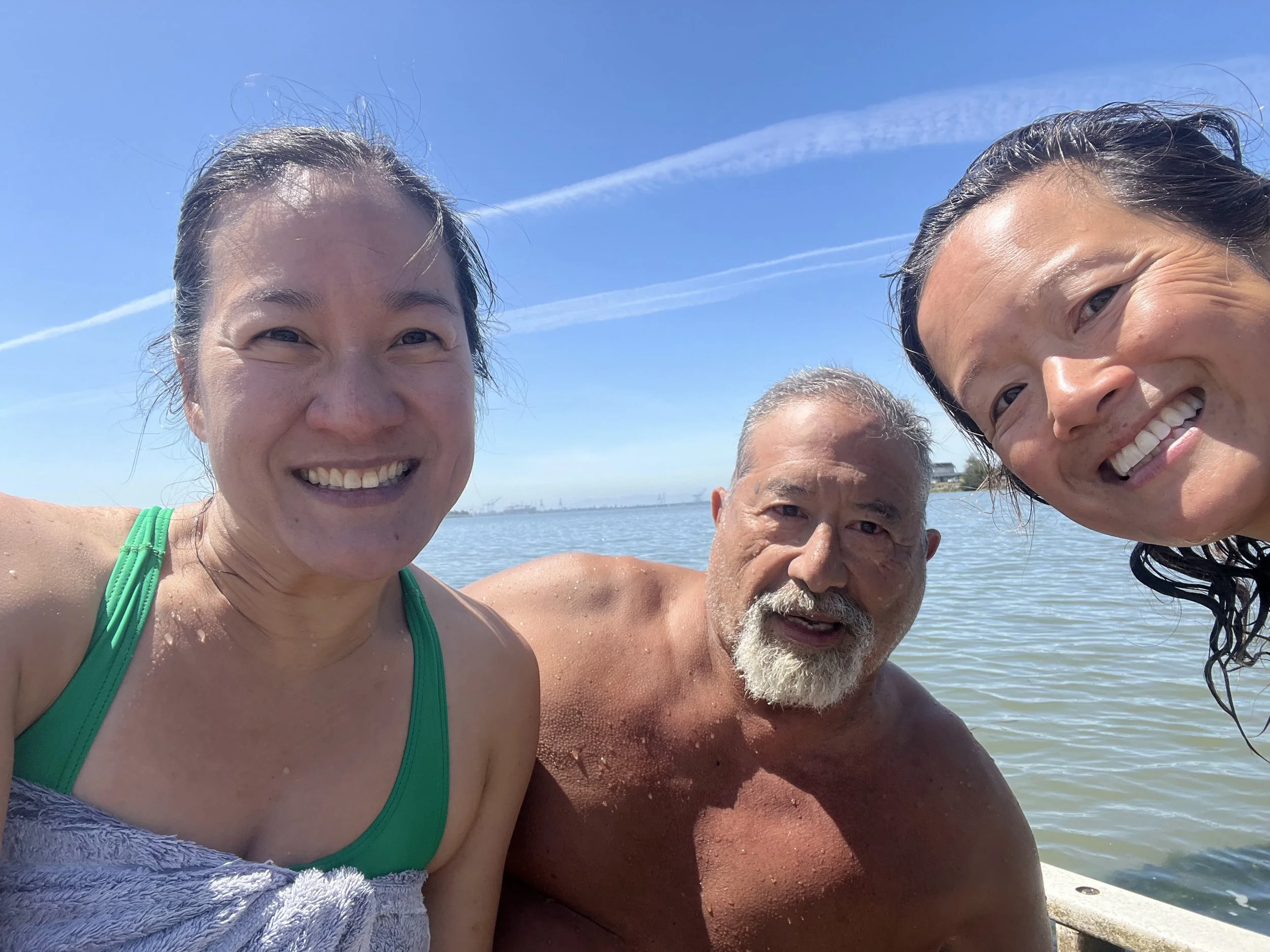
Three friends embarking on a chilly dip.
It’s 10:00 AM and the tide is slack. It is an exquisite morning at the Berkeley Marina, but as I stand on the floating pier waiting for my friends to arrive, my eyes are fixed on the frigid San Francisco Bay. No matter how warm the air temperature gets, 56°F water is always a violent shock to the system.
We swim for 847 yards over the course of 30 painstaking minutes. That breaks down to nearly a 3:30/100-yard pace. At this rate, it would take me an hour to swim a single mile, over six hours to complete a 10K, and more than ten hours to cover ten miles. Contrast that with my typical pool pace of 1:50/100 yards, and the math is humbling. When I finally emerge from the water, my lips are blue and my brain is delightfully loopy as mild hypothermia begins to set in.
All year, I’ve been testing the waters for an aspirational goal that has haunted me for more than two decades: a true marathon swim. After a few punishing open-water sessions like this one, combined with a 5,000-yard benchmark set in the pool, I did what any worn-out, determined mom would do.
I signed up for Swim the Suck.
I’ve run more than 15 marathons, completed two Ironman triathlons, and biked across the country. Yet, I’ve never truly tested my limits in the alien world of marathon swimming. Now, with just three months left to train, I am staring down a 10-mile commitment. This isn't just about finishing; it’s an exploration of limits, rhythm, and what it means to keep moving forward when you can no longer see the shore. And I’m scared.
What is Swim the Suck?
The race begins at the mouth of Suck Creek—hence the name—and winds in a serpentine S-pattern through the Tennessee River Gorge. Towering, forested limestone canyon walls rise hundreds of feet above the riverbanks, offering an immersive, linear tour of a massive wilderness ecosystem rather than the repetitive, dizzying loops of a traditional open-water course.
The 10-mile route runs entirely downstream. Participants generally benefit from a favorable tail current generated by upstream dam releases, with a six-hour cutoff to complete the course. However, the river environment remains highly unpredictable. Autumn winds blowing against the current can instantly transform glass-smooth water into a disorienting, choppy washing machine, forcing swimmers to constantly adapt their stroke during a three- to five-hour endurance test.
I chose this race because that downstream current offers a welcome safety net. Additionally, the autumn water temperatures hover comfortably between 74°F and 78°F. The finisher "medal" is actually a beautifully hand-crafted artisanal mug. And finally, the race organizers possess an excellent sense of humor—there is even an official prize for the person who manages to stay in the water the longest. Looking at my current open-water training pace, that prize might just be mine for the taking.
Over the coming weeks, I’ll be sharing my training architecture, progress updates, gear breakthroughs, and nutrition strategies. Stay tuned—the journey to Tennessee starts now.